The crime story of Eddie Tipton shows how two words and a store camera undid a lottery rigging scheme
· based on the channel Max Crime
The crime story of Eddie Tipton is the case of a lottery security chief who rigged his own employer's draws and was undone by a store camera and two ordinary words: "No thanks." Tipton, information security director at the Multi-State Lottery Association, wrote and controlled the random number generators behind games such as Hot Lotto, then used that access to make certain draws predictable. A $16.5 million Hot Lotto ticket bought in Des Moines went unclaimed for nearly a year, and the investigation that followed ended with a 2017 guilty plea.
What the crime story of the rigged Hot Lotto draw involved
The Multi-State Lottery Association (MUSL) is a nonprofit owned by member state lotteries; it supplies games, drawing equipment and random number generators. Tipton worked there as information security director, which meant he helped build and maintain the systems that picked winning numbers. Employees of MUSL and its member lotteries were barred from playing the games they helped run.
According to the prosecution, Tipton inserted code into the random number generator that let him predict or control outcomes on specific dates. The rigged draws were not random at all: the numbers were constrained to a set he could know in advance. He then had associates buy tickets in the affected draws.
The Hot Lotto ticket at the center of the case was purchased at a Des Moines convenience store in December 2010. It matched all the numbers and was worth $16.5 million. Under Hot Lotto rules, the winner had to come forward within a set period, and for most of a year nobody did.
How the claim fell apart before the money was paid
A lawyer eventually presented the ticket on behalf of an anonymous trust, with just over an hour to spare before the deadline. That alone drew scrutiny: legitimate winners rarely hide behind a trust and a lawyer, and lottery officials began asking who actually bought the ticket.
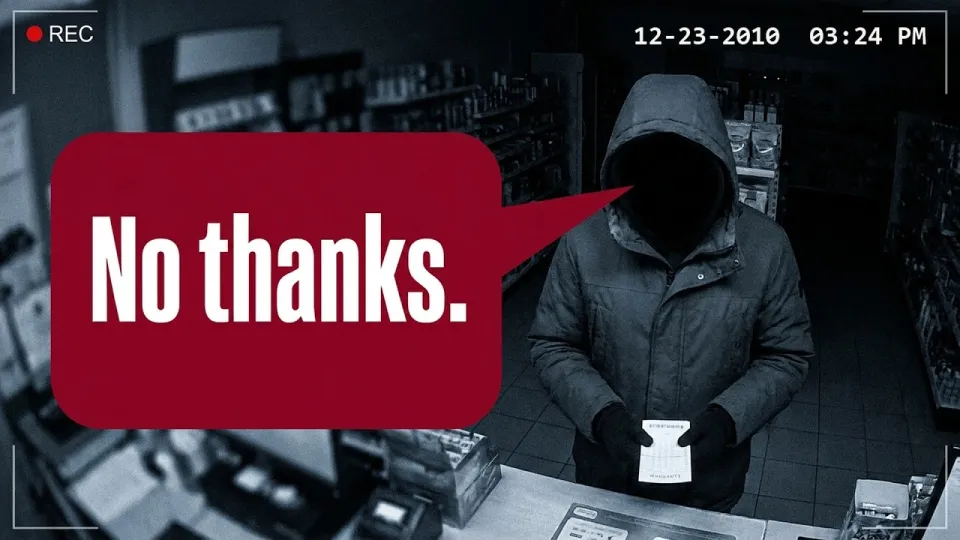
Investigators pulled the store's surveillance recording. It showed a man buying the ticket and then walking away when a clerk asked whether he wanted a receipt or further transactions; the words "No thanks" were captured on the audio. In 2014 the Iowa Division of Criminal Investigation released the footage publicly and asked for help identifying the man.
Coworkers at MUSL recognized him. They knew the voice, the build and the way he moved, and several contacted investigators. The man on the tape was the security director who had designed the systems meant to keep the games honest.
Why the draw room camera could not clear him
The computers that generated winning numbers were kept offline, isolated from the internet, in a secured room. Access was limited, and the room was monitored by a camera that recorded roughly one second of footage every minute rather than a continuous feed. That gap was enough to make the recording useless as an alibi or as direct proof of tampering.
Instead, the case rested on the code itself. Examiners found that the random number generator had been altered: a rootkit-style modification let the software produce numbers that were not truly random on chosen dates. Because the same program was used across multiple games, the flaw affected more than one draw.
The timeline that mattered:
- December 2010: the Hot Lotto ticket is bought in Des Moines.
- Late 2011: a lawyer submits the ticket for an anonymous trust shortly before the claim deadline.
- 2014: investigators release the store recording and coworkers identify Tipton.
- 2015: Tipton is tried in Polk County; he is convicted.
- 2017: he pleads guilty to manipulating the code used to generate winning numbers.
The appeal over a legal deadline
After the conviction, the defense appealed to the Iowa Supreme Court, arguing among other things about the timing of the case and the handling of evidence. The court's ruling in State v. Tipton (No. 15-1515) addressed those procedural questions and left the conviction standing.
The legal fight mattered because it showed how a case built on computer code can be attacked: the evidence is technical, the records are old, and every step has a deadline. Prosecutors had to show not only that the generator was flawed but that the flaw was deliberate and that Tipton was the person who put it there.
What the guilty plea established
In 2017 Tipton admitted in court that he had manipulated the code used to generate winning numbers. The plea resolved the criminal case and confirmed the central claim of the investigation: the draws had been tampered with from the inside by the person responsible for securing them.
The $16.5 million Hot Lotto prize was never paid on that claim. The trust that tried to collect it got nothing, and the associates who bought tickets in rigged draws became part of the wider inquiry.
The case is a reminder that lottery security depends on people as much as machines. A random number generator is only as trustworthy as the person with the credentials to change it, and the controls around that access are what actually protect a draw.
Why this crime story still matters
The Tipton case is one of the clearest examples of insider fraud in a gambling system, because the fraud was built into the tool everyone else relied on. It also shows how ordinary evidence can break a technical scheme: a store camera, a voice, and a two-word reply did more than any audit.
Max Crime's breakdown of the case follows it in order, from the unclaimed ticket to the hidden trust, the released footage, the trial, the appeal and the plea, using court records and the Iowa DCI's video as its backbone.
Key takeaways
- Eddie Tipton was information security director at the Multi-State Lottery Association, the body that runs games such as Hot Lotto for member lotteries.
- A Hot Lotto ticket bought in Des Moines in December 2010 was worth $16.5 million, and the prize went unclaimed for nearly a year.
- The winning numbers came from a random number generator Tipton had access to; investigators found the code had been altered to produce predictable draws.
- A store recording released in 2014 showed the buyer, and coworkers recognized his voice and the way he moved.
- Tipton pleaded guilty in 2017 to manipulating the code used to generate winning numbers; the $16.5 million claim was never paid.
Questions & answers
Who is Eddie Tipton?
Eddie Tipton was the information security director at the Multi-State Lottery Association, the nonprofit that supplies games and random number generators to member state lotteries. He was convicted and later pleaded guilty to manipulating the code used to generate winning lottery numbers.
How was the lottery rigging discovered?
A $16.5 million Hot Lotto ticket from a December 2010 draw in Des Moines went unclaimed for nearly a year and was then submitted through a lawyer for an anonymous trust. Investigators released store surveillance footage in 2014, and coworkers recognized Tipton's voice and manner, which led back to the altered random number generator.
What did the two words "No thanks" have to do with the case?
The store recording captured the ticket buyer declining something with the words "No thanks." Combined with the image of the man, that audio helped colleagues identify Tipton, turning an anonymous claim into a named suspect.
Was the $16.5 million prize ever paid?
No. The claim submitted for the anonymous trust was never paid, and Tipton's 2017 guilty plea confirmed that the draw had been manipulated. The money stayed with the lottery rather than going to the people behind the claim.
Source: He Rigged the Lottery. Two Words Gave Him Away. (crime story) · Markdown version